The Blog

Another round of private (but just about public) testing!

In the past year we’ve written a bit about both 2013 and OmniOutliner 4; now we’re ready to let you see the next generation.

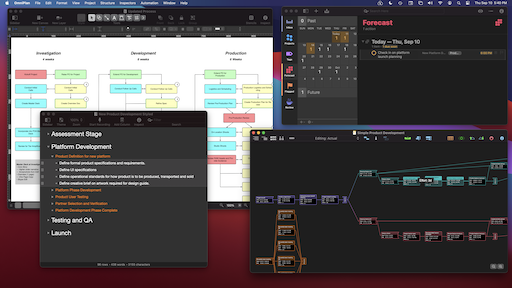
OmniOutliner 4 screenshot

Who?

We’d like anyone who uses OmniOutliner on most days to give it a go. Have a particular template or document you live out of? Try your workflows in OmniOutliner 4 and let us know if bugs happen. Real-world information here is extremely critical to a great public release of v4.

It’s important to note that OmniOutliner 4 has been completely rewritten and requires Mountain Lion (10.8).

If you’re in and have the time, sign up for the private OmniOutliner Test. We’re sending out the first round of invitations…

When?

Right now! Well, shortly after you sign up anyway. We’d like to get tens to hundreds of thousands of private testing hours before starting a “Hey stranger, come download this app” public test.

If you emailed us on your own accord in the past few months, you should have already received your invitation to test.

Is there anything missing?

Not missing, but possibly buggy! In February we finished adding the bulk of support for AppleScript (rewritten!) and printing (rewritten!), and you’ll see audio recording show up soon, too.

And the final version?

We’ll know when we’re ready after hearing from you. We want OmniOutliner 4 to be just as stable as OmniOutliner 3, and a good group of private testing with a lot of unique usage helps a great amount. Sign up, give it a go, and let us know what you find!

Debut of OmniFocus 2

by Ken Case on February 1, 2013 | 136 Comments

As I said in my blog post announcing OmniFocus 2, our goals for version 2 are to bring back to the Mac all of the design and innovation that went into our iPad edition of OmniFocus: dedicated Forecast and Review modes, clearer navigation, and a fresh look and feel. And from the reaction from people I talked to at last night’s debut, it sounds like we’ve done just that!

OmniFocus 2 main screenshot

As with the iPad app, all navigation is now done through a unified sidebar: there is a single sidebar that includes your Inbox, Projects, and Contexts, as well as your Forecast of upcoming scheduled work, a list of Flagged tasks, and list of projects that need Review. The main navigation headers stick to the top or bottom as you scroll, so they’re always visible and accessible with a single click no matter where you are in the list.

OmniFocus 2 Forecast screenshot

The new Forecast mode shows you a summary of your upcoming time-based commitments at a glance in the sidebar. You can leave the forecast collapsed to see the next several days (as in the screenshot), or expand the forecast to see an entire month in your sidebar. From the forecast, you can select any combination of days to see a detailed schedule that includes scheduled tasks from OmniFocus integrated with events from your calendar.

With version 1 of OmniFocus it was already easy to add new items into your system—using the built-in Quick Entry on Mac, or Siri on the iPhone and iPad, or by sending email to your Inbox. Perhaps a little too easy: after using OmniFocus for a few months, OmniFocus could easily become cluttered with cruft that seemed important at the time, but is no longer relevant to the work you need to get done today! This is the problem we aim to solve by bringing Review mode to OmniFocus 2 (which we originally pioneered in the iPad app). Review mode walks you through reviewing any projects which you haven’t reviewed recently, making it easy to update your projects to make sure they reflect your current priorities.

Now that information about OmniFocus 2 is public, we’re happy to answer any questions you might have about it! Some of the obvious questions are:

Will this require new versions of OmniFocus for iPad and iPhone?

No, we’re not updating OmniFocus for iPad or iPhone at this time: OmniFocus 2 for Mac is designed to sync with the current shipping versions.

How soon will OmniFocus 2 be shipping?

The simplest answer to that question is that I don’t really know! A more accurate answer is that the answer really depends on what feedback we receive from all of you. We use an iterative development process at Omni, so our next step is to ship a private test release so we can get feedback from customers on how well it’s working in practice. Based on that feedback, we’ll update our design and ship another private test release (and invite more people into the test pool), and the cycle begins again. How many times we repeat that cycle depends on how long it takes for us to feel like we’ve achieved our goals for the release.

Once we finish those rounds of private testing, we’ll post a wide-open public test release for anyone to download from our website, and finish up some of the other hard work of writing documentation, translating the app and documentation to other languages, and submitting the app to Apple for App Store review. Usually this final stage takes 4-6 weeks—at that time, it should be much easier to accurately project a ship date.

How much will OmniFocus 2 cost?

OmniFocus 1 has been very successful at its current price point of $79.99—and we think that’s been providing great value for its current target audience of professional customers. But with OmniFocus 2 being much more approachable, we think there’s also an opportunity to reach a wider audience who don’t need all of the Pro features from the current edition. So we’re going to offer two editions of OmniFocus 2:

The Standard edition of OmniFocus 2 will include all of the basic features which we’ve talked about above, and will cost $39.99.

The Pro edition of OmniFocus will offer the option of building custom workflows like OmniFocus 1 does today, with its support for Perspectives and AppleScript.

Will there be a discount for current owners of OmniFocus 1?

Yes, on our online store we’ll be offering a 50% discount to current customers of OmniFocus 1, whether you originally bought directly from us or through the App Store. This means that current customers will be able to upgrade to the Standard edition of OmniFocus 2 for $19.99, or to the Pro edition for $39.99.

We would love to offer the same deal to people who wish to purchase OmniFocus 2 from the App Store, but unfortunately the App Store has no mechanism for offering selective discounts to different customers based on their previous purchases.

Will volume or educational discounts be available?

Yes, we will continue to offer volume discounts through our standard online store, and educational discounts through our Education Store.

What if I don’t own OmniFocus already? What should I buy today, and where should I buy it?

From now on, anyone who purchases OmniFocus 1 from our online store will receive a free upgrade to the Professional edition of OmniFocus 2 when it ships.

Omni’s Plans for 2013

by Ken Case on December 21, 2012 | 60 Comments

In my last blog post, I reflected on all the things we accomplished in 2012 here at Omni—in particular, the completion of our huge “iPad or Bust!” initiative. But as Professor Hathaway said to Chris Knight, “That was yesterday. What have you done for me today?”

With “iPad or Bust!” out of the way, we’ve been able to move some of our projects off the back burner and here are some highlights of what’s coming: OmniFocus 2. OmniOutliner 4. Automatic document syncing. Sandboxing. Accessibility. Visio and Microsoft Project compatibility in our iPad apps. Upgrade pricing from Mac App Store apps.

Junction: Omni 13, OmniFocus 2, OmniOutliner 4

Let’s start with OmniFocus 2! For OmniFocus 2, we’re bringing back to the Mac all of the design and innovation that went into our iPad edition of OmniFocus: dedicated Forecast and Review modes, clearer navigation, and a fresh look and feel. I’m looking forward to sharing it with you! At 6pm on January 31, you’re invited to join Merlin Mann, David Sparks, and me for the first public debut of OmniFocus 2. This will be a free event, hosted at the Cartoon Art Museum (a short walk from Macworld/iWorld), and anyone who attends will get early access to the OmniFocus 2 private beta. Space is limited, so if you plan to attend please let us know.

Next up: OmniOutliner 4! I know many of you have been waiting for this upgrade for a long time—I know I have been waiting for this for a long time! For those of you who might not know the history, OmniOutliner 3 shipped in January, 2005—one year before Macs transitioned to Intel processors. And OmniOutliner 3 certainly hasn’t sat still over the last eight years: we’ve ported to Intel processors and added support for Spotlight, dictionary lookups, LinkBack, Automator workflows, Quick Look, custom toolbars, Word 2008 export, Auto Save, and Versions. But other than a few tweaks to the inspectors and toolbars, its design has mostly stayed the same: it’s starting to feel a bit long in the tooth. So… it’s due.

What’s coming in OmniOutliner 4? We’ve completely rebuilt the outlining engine to support zooming text, showing and hiding columns, and we’ve improved link handling and attachments. We’ve designed a new style system which emphasizes named styles and simplifies the styles interface. And it’s built on a modern 64-bit architecture, with a fresh new look and feel. OmniOutliner 4 isn’t finished yet, but it’s getting close: it’s now at the point where I’m using it to edit all my outlines rather than OmniOutliner 3, so I anticipate we’ll be ready for public beta sometime in the first quarter.

Automatic document syncing is almost here! We call it “OmniPresence”: your documents, synced everywhere you want them to be.

We’ve designed OmniPresence around open web protocols, so you’re welcome to use our free Omni Sync Server or to host your own cloud server. We think that the option to host your own cloud is important—not just because of concerns with respect to privacy and security (though that’s key for many businesses), but because it means you can keep that cloud running as long as you want to keep using it. As we saw with MobileMe shutting down earlier this year, individual cloud services can easily disappear as business models change. Building a solution around open standards means that our customers have a choice of hosting providers rather than being tied to a single ephemeral cloud solution.

OmniPresence is not limited to syncing with a single cloud, either: you can choose which folders to sync with which clouds. This means that teams can set up separate folders in separate clouds, and you can access files from any of them on each of your devices.

Because it’s open and you can host your own cloud, OmniPresence is designed to sync any documents you want: it’s not limited to syncing documents created by our apps. In fact, on the desktop OmniPresence is completely independent of our other apps: if you wish, you can use it to sync TextEdit documents! (But when using OmniPresence with non-Omni apps, we’ll ask that you limit the amount of space you use on our Omni Sync Server since we can’t provide infinite storage to everyone for free. On your own cloud server, though, do whatever you want!)

On iOS, OmniPresence isn’t quite that independent: the sandboxing environment requires that each app embed the OmniPresence logic within its own codebase. We will be publishing our source code for free so other developers can add it to their apps.

OmniFocus 2, OmniOutliner 4, and OmniPresence. Three major upgrades, all coming your way in Q1, 2013.

But as I noted at the top, that’s not all! We’re also working on sandboxing to help keep your Mac safe; and accessibility (currently in private beta for OmniOutliner for iPad) to make our apps easier to use by those who are visually impaired. And we’ve been working on adding Visio and Microsoft Project compatibility to our iPad apps, so it will be easier than ever to go completely mobile with your work.

Finally, with OmniFocus 2 coming we’ve been thinking a lot about how to implement upgrade pricing from Mac App Store apps. As always, we plan to offer discounted upgrade pricing on our own online store, but unfortunately we don’t have the flexibility to offer selective discounts in the Mac App Store. We’ve decided to treat the Mac App Store the same way as we treat retail stores: it’s a great way to discover our software, and can give you confidence that it’s been vetted by a third party. And, just as you wouldn’t get a discount from a retail store if you purchase OmniGraffle 5 while owning OmniGraffle 4, you won’t get a discount if you purchase OmniFocus 2 from the Mac App Store. But we’re in the process of updating our store so that you’ll be able to register your Mac App Store apps to get a discounted upgrade price when you buy an update directly from us.

OmniFocus 2. OmniOutliner 4. OmniPresence. Sandboxing. Accessibility. Visio and Microsoft Project compatibility in our iPad apps. Upgrade pricing from Mac App Store apps. I hope you’re looking forward to 2013 as much as we are! (And don’t forget to let us know if you’re planning to come to the OmniFocus 2 debut!)

Macworld is almost here!

Join us, if you would, on January 26th, 27th, and 28th at booth 802. (There’s no need for a map; it’s extremely close to the Exhibit Hall entrance.)

We won’t beg, but we’d love to see long-time users, show our stuff to some new users, and give away some Pretty Cool Things we had made up.

This is actually our 12th straight attendance, but I’m calling this Number One, because Frakes. And Ihnatko! No big deal.

There’s always something worth checking out at Macworld — at the very least, follow along with our Instagram (omnigroup) feed or our posts on Twitter: @omnigroup. We’ll be posting awesome things throughout our stay which will all be newsworthy, I’m sure.

Also: OmniPlan for iPad previews and a quick presentation on Friday at noon!

Take a gander at our presentation lineup by heading over to our permanent Macworld page, or read ahead.

Lastly, if you know of a fantastical ramen or dumpling place we should check out while we’re in San Francisco, comment or email!


Thursday
11:15OmniGraffle: Space Planning
12:00OmniOutliner: Building a Budget
1:15OmniGraphSketcher: Data Visualization
2:00OmniFocus: Weekly Review
2:45OmniOutliner: Crafting Classy Documents
3:15OmniGraffle: Basic Wireframing
4:00OmniFocus: Daily To Do List
Friday
10:30OmniOutliner: Crafting Classy Documents
11:00Ken Case Q&A
12:00OmniPlan for iPad: First Look!
1:15OmniGraffle: Basic Wireframing
2:00OmniOutliner: Building a Budget
2:45OmniFocus: The Basics
3:15OmniGraffle: Space Planning
4:00OmniFocus: Review
Saturday
10:30OmniGraphSketcher: Data Visualization
11:00David Sparks
12:00OmniGraffle: Space Planning
1:15OmniFocus: The Basics
2:00OmniOutliner: Building a Budget
2:45OmniGraffle: Basic Wireframing
3:15OmniFocus: Review
4:00OmniOutliner: Crafting Classy Documents

Here we are

Almost two years ago, we opened registration for a brand new service: the Omni Sync Server. It was introduced slowly, of course, shared via email to folks who had trouble with MobileMe sync conflicts or setting up their own WebDAV server. Next, we invited users via Twitter and our OmniFocus forums to expand our base a bit more. (We survived that!)

At that point, we didn’t know whether the service would be free. We announced publicly in December of 2010 that it would. It isn’t free for us—about five or six folks here have had their hand in the design/implementation/upkeep/engineering of OSS—but definitely worth it. But! it’s reasonably fair to say that OmniFocus paired with OSS makes for the best experience.

So, in the past two years, it’s been pretty great — with a few exceptions. We’ve taken it down to physically move our servers to the next rack over; we’ve had a few cases of the early-morning Mondays (I’m so sorry I said that) because of I/O difficulties when sign-ups started ramping up. (Technical note: we were also using our first Mini to redirect everyone to the appropriate machine; it was overwhelmed.)

We’re now fine-tuning the system and preparing for worst-case scenarios as much as we can be:

  • What if a Mac Mini jumps off the rack at our colo facility?
  • What if a drive dies on each Mac Mini at the same time?
  • Other relatively bad thing.

Soon, after we get all of that figured out, we’ll be taking the Sync Server out of beta. Edit: It sounds a bit like we’re not currently backing things up; we are! We’re also finalizing our EULA — we want something that we like and which our lawyers will tolerate. (We’ve removed the beta badges in our apps in preparation for this; the site’s warning remains.)

What’s next?

We definitely have some ideas for a great new OmniFocus feature or two involving OSS. We also have plans to use it more and more for all of our document-based apps (see: everything else), and will move away from importing/exporting and over to syncing of documents.

Twitter-folk can stay up-to-date here with news and announcements.

We really like iCloud, but there’s still a lot we, as developers, just don’t know. Hopefully we’ll find out more in the coming month(s).

Some data from sync clients

We tweeted yesterday that exactly 31,500 users were active on our servers in the last 8 days. The most interesting bit, I think, is the most popular OS X machine: the 2011 Macbook Air. 10%, with 7% of the 13” and 3% of the 11”.

Five folks do their OmniFocusing on an Xserve. (There’s nothing wrong with that!)

Marco Arment, developer of Instapaper, occasionally shares some of his iOS statistics. I’d suggest heading there for a better breakdown of what it actually means for developers, but this is interesting:

  • 92% of the devices using our Sync Server are completely up-to-date on iOS 5.0.1.
  • Because of rounding, we can say that nearly 100% of our users are running at least 4.2.1
  • 68 devices of 38,741 are running something less than iOS 4.

And finally, for the OmniFocus geeks:

SetupCount%
iPhone+Desktop909329%
All 3592119%
Desktop only544417%
iPhone only372812%
iPhone+iPad23928%
iPad only20697%
iPad+Desktop17936%

Keep in mind that these are active devices in the last 8 days. In our latest versions of OmniFocus, we decided to up our minimum OS version to 4.0, so users that are less likely to upgrade their OS might also be less likely to explore syncing.

From all of us in the support department here at Omni, Happy Holidays! (The rest of Omni also wishes you the best.)

This is a very quick note to thank everyone for, over the course of 2011: 41,805 emails, 3,763 phone calls, and a decent amount of tweets. And a few more before the 31st, I’m sure!

While you’re off visiting with family and friends, try not to let us waste the day away, though. We’ll still be scattered about on our Macbooks and iPads—at slightly reduced hours—while we visit family around the US. (Also, Iceland and Great Britain!)

Phone support, too. Leave a message during normal west coast business hours and we’ll call back ASAP.

That’s all. Happy New Year!

Howdy, everybody! With a new release of iOS and new iPhone hardware, there’s been a ton of excitement and news this week; fun times!

In addition to all the cool new stuff Apple’s released, we’ve been able to build a few things using their toys that we hope will also be pretty exciting; I wanted to take a few moments and tell you about one of them. Specifically, the new location-based notifications we’ve added to OmniFocus for iPhone 1.12 and OmniFocus for iPad 1.4!

One of the first things we added to OmniFocus was time-based reminders; it wasn’t too long after that that folks asked for location-based ones as well. In fact, the first request we got for location-based reminders was back in May of 2007, before we’d even shipped version 1.0 of the Mac app! Over the years, we got more requests, especially once OmniFocus for iPhone and iPad appeared - wouldn’t it be great if the device you were carrying around in your pocket could tell where you were and remind you of the things you needed to do?

The first couple versions of iOS mostly made use of location data on maps. It was useful - you could create a context for a pharmacy you used, add the address, and see a dot on the map if any actions needed doing. You had to remember to look at the map screen, though. With iOS 4, it started to look like the pieces we needed to add the feature were coming together - that version of the OS had the ability to monitor location information and notify an application when the device was in a certain area. We did some preliminary work towards implementing location reminders; the feature worked and didn’t use much battery charge, but it became apparent it wasn’t as fast or as accurate as we hoped. We decided to pause work on the feature.

We were pretty excited by some of the changes Apple made in their recent hardware, though; they found a way to improve the accuracy of location monitoring without using more power. Specifically, the iPhone 4 (and 4S) include a feature called “region monitoring”, which lets them track the devices’ location via GPS without running down the battery. iPad 2 models with 3G also have this capability. Unfortunately, devices released before then don’t have a low-power way to monitor their location as accurately, so they won’t be able to use this type of reminder in OmniFocus. (The Reminders app included in iOS 5 has the same limitation.)

Still, if you have a device that supports it, the location reminders can give you an extra nudge, helping you to complete actions you might otherwise forget. Because battery life is a top priority, though, it’s important to remember that the location is only being checked from time to time. If you pass through an area quickly (by driving past it on the highway, for example) you may not get an alert. It’s also important to note that the regions being monitored are fairly broad - the smallest “distance” setting still corresponds to about one city block, and things get more broad from there. Hopefully in the future we’ll have never-fail pinpoint-accuracy location monitoring, but we’re not quite there yet.

Since we shipped this feature, we’ve gotten questions from some customers that are seeing the “your location is being monitored” indicator more often than they used to, and it’s true that it’ll show up more often. As long as you have an available action in a context with a location attached, OmniFocus will stay subscribed to location information, activating that indicator.

The folks that are concerned by this are usually worried that their battery will be drained more quickly, and in previous versions of iOS, that would have been the case. In iOS 5, though, you shouldn’t have to worry as much. Behind the scenes, iOS 5 is handling things. We can’t know the exact details of how it works, but Apple’s stated goal was to be reasonably accurate while minimizing battery drain. The location monitoring indicator is mainly to help you manage your privacy; avoiding battery drain was a useful side-effect. But in iOS 5, the device is better able to conserve the battery.

It may also be helpful to know that OmniFocus’ map view also shows the indicator: that view determines your location more precisely than the location reminders do - you will see some battery impact there. In fact, shortly after shipping the iPhone update, we discovered that the Map view doesn’t remember to stop monitoring your location after you close the view; that actually can cause battery drain! Thanks to the folks that reported this problem - we’ll get an update out that fixes that as soon as possible.

For more details on location reminders, check the new help pages; they’re accessible from the Settings screen in each app. In the meantime, I hope this post helps you decide if location reminders will work for your purposes. Have ideas, suggestions, or concerns? We’d love to know what you think! Drop some comments here, or email our support ninjas; you’re also welcome to ask questions in our forums or on Twitter. Thanks, everyone!

“Wow, your customers are nerdy!”

That was a friend’s response recently when I mentioned that logarithmic axes are the number-one feature request for OmniGraphSketcher.

The way I see it, our customers understand that logarithmic scales are the best way to present many types of data and ideas. Stock prices, advances in technology, and many other phenomena tend to change by multiples rather than additions. Logarithmic scales show each doubling as a constant distance, so you can compare percent changes without large differences in absolute size getting in the way.

So I’m very excited to announce that OmniGraphSketcher 1.2 for Mac and OmniGraphSketcher 1.5 for iPad are now available, with full support for logarithmic axes!

Logarithmic axes example

You don’t even need to know anything about logarithms to use this feature. You just turn it on via the axis inspector, for either or both axes. (The resulting charts are sometimes called lin-log and log-log.) There is no step two!

These logarithmic axes are designed to follow best practices in information visualization, and they work seamlessly with all the other features of the app, such as dragging, nudging, snapping, sketch recognition, axis manipulation, and scale-to-fit. And because logarithmic scales are more likely to span many orders of magnitude, we now support much larger and smaller numbers (up to 10300 and down to 10-300), more decimal precision (up to 13 digits), and scientific notation (so you can use numbers like 3 x 10200 without typing 200 zeroes).

Given that the known sizes of physics only range from about 10-35 meters (the Planck distance in quantum theory) up to 1026 meters (the size of the observable universe), we figure that +/- 300 orders of magnitude should be plenty.

At least for now.

As part of these updates, we’ve also refined the algorithms that draw axis tick marks and tick labels. When there is not enough room to label every tick mark, we now consistently label every other tick mark, or every 5th, or every 10th, etc. If we skip a lot, we’ll automatically use major/minor tick marks to make it easier to see which tick marks are getting labeled.

Automatic major/minor tick marks

On logarithmic axes, we show just the first five numbers between each power of ten when possible, then only the powers of ten themselves, and then evenly-spaced powers of ten. OmniGraphSketcher makes all of these decisions for you, so you never have to think about it.

Tick labels from 1 to 50 Tick labels from 1 to 1000 Tick labels from 1 to 10^25

And did I mention that your axis ranges don’t have to end on powers of ten? Suppose your data values fall between 8 and 200. In many charting programs, the best you can do is this:

Axis range limited to powers of ten

But we think logarithmic axes should be just as flexible as linear ones, and we want you to be able to switch between linear and logarithmic scales seamlessly. Again, we’ve done the work so you can get what you’d expect:

Fully customizable logarithmic axis range

Last but not least, we’ve added a really nifty new feature called line interpolation. As you know, OmniGraphSketcher lets you draw lines freehand even if you don’t have exact data to back them up. This is great if you have a rough idea of a trend or want to visualize several possible scenarios. But wouldn’t it be cool if you could also turn your sketched lines into sampled data points for analysis or re-plotting in another program? That’s exactly what line interpolation does. It samples at each horizontal tick mark (x-value) to convert your line into a data series.

The reason we’re introducing this at the same time as logarithmic axes is because it lets you see how the shape of a line differs in linear vs. logarithmic space. Regular lines in OmniGraphSketcher simply connect two or more data points as smoothly as possible, so intermediate values do not necessarily stay the same when you convert between linear and logarithmic scales. Line interpolation solves this by letting you anchor some of the intermediate points. Now you can easily demonstrate, for example, how a straight line in logarithmic space becomes an exponential curve in linear space:

A straight line in logarithmic space becomes an exponential curve in linear space.

Download the latest versions of OmniGraphSketcher from the App Store (Mac, iPad) or from our online store (Mac); or use the built-in software update to download automatically.

And let us know what you think!

(If you want all the details, check out the release notes for the Mac and iPad versions.)

We're thrilled to announce that OmniPlan v2.0 ships today! Since releasing OmniPlan v1.0, we've learned a lot about how people are using OmniPlan to manage their projects and we think that OmniPlan v1.0 grew into an excellent resource for project planning workflow for a single person. However in undertaking OmniPlan v2.0, we knew that people wanted to bring this workflow and user experience to their teams — and so that's what we focused on: collaboration.

Collaboration in OmniPlan v2.0 allows a manager to create and share a project with their team. By syncing over MobileMe, Omni Sync Server or a WebDAV server, teams are able to synchronize their work and stay up to date on the latest changes.

While collaboration is the most exciting new feature, OmniPlan v2.0 also adds scheduling and printing options and improves performance with large projects to add speed and versatility to your workflow.

We know a lot of you have been anxiously waiting for this, so let's jump right into some of the new features we've added in OmniPlan v2.0:

Collaboration: Sync, Publish, Edit, and Track Changes 

Use a WebDAV server to sync your projects between resources. Then, publish your tasks automatically upon saving. Grab new changes automatically via Bonjour or at a specified interval. (You can also publish and update manually, of course.) Publish tasks and pull in updates from a server-based calendar. Export your plan automatically in any supported format. Execute custom AppleScripts from within the app during export.

Use Apple's Calendar Server to pull in free times and busy times for your resources. Import vacation and holiday schedules from a web-hosted calendar.

Keep track of the changes to the project with visual change tracking. See your own edits on a personal project or see the synced changes on a team project. Accept and reject changes on a task-by-task basis or all at once. 

Scheduling

Fiscal years are now supported in addition to calendar years so you can choose whether your tasks are due in Q2 or Spring. Schedule projects backwards from a fixed end date. Create, save, and compare your projects against multiple baselines. Highlight the critical path to individual milestones in the new ‘‘Project: Milestones’’ inspector. Resource schedules now have optional start and end dates.

Tasks and Resources

Split your tasks to schedule around interruptions. Create hammock tasks that have start and end dates based on prerequisites that you define. Effort and Duration can now be unlinked. Default task and resource attributes can be configured per project or in a template for faster task creation. Color-code tasks based on their resource. Choose independent display formats for duration and effort values.

Filtering

Save multiple, commonly-used filters for quick re-use later. Configure publishing actions to use filters.

Printing Options

Headers and footers are now more flexible. Expand or collapse all notes and task and resource groups. Page margins support mirroring on facing pages. Customize the margin above and below the header and footer.

OmniPlan v2.0 is available from our store and from the Mac App Store for $199.99. Folks who purchased OmniPlan v1.0 from the Mac App Store and our online store between January 6, 2011 and July 17th, 2011 will receive a free upgrade to OmniPlan v2.0. For folks who purchased OmniPlan v1.0 before that date, an OmniPlan v2.0 upgrade is available from our online store for $99.99.

We hope that you'll enjoy the new features, improvements, and updated user interface in OmniPlan v2.0. We've been working very hard on this new version and we're looking forward to hearing your thoughts about OmniPlan v2.0:  please send any feedback, questions or comments to us at omniplan@omnigroup.com and someone from our team will get back to you as soon as possible.

Thanks to all our customers for your amazing show of support for serious iPad productivity apps!  Three weeks ago we launched OmniOutliner for iPad, and I'm very pleased to announce that we sold our 10,000th copy of the app yesterday.

More importantly, our reviews on the App Store are averaging four stars and we've been hearing great things about the app from all of you:

@stanlemon: @kcase your crew really knocked it out of the park today with @OmniOutliner for the iPad. Bravo!

@rwilcox: Omnioutliner iPad is so much more than I ever imagined. Never been so blown away.

@PaulWestlake: Used @OmniOutliner on the iPad in my first meeting today. Wow... This is going to replace so many of the apps on my iPad. Stunning. Buy it!

@JustOrtiz: OmniOutliner for iPad was the reason I wanted an iPad when it first came out. Well worth the wait. It's finally made the iPad what I need

@jdriscoll: Spent some time with OmniOutliner for iPad last night and was blown by the 1.0. Great work @omnigroup.

So with over 10,000 sales and great reviews it looks like version 1.0 is off to a great start!

But version 1.0 is just where our apps start, it's not where they end:  today we're putting the final touches on a version 1.0.2 update, which fixes a number of bugs and adds a few minor enhancements, such as autoscroll for dragging rows and document sorting by title.

And we won't be stopping at version 1.0.2 either, of course. Many of you have also asked us for a better document management interface and for automatic document synchronization, so those are some of our top priorities for the next few updates.  We've been inspired by the improvements Apple has made in the iWork apps earlier this week (yay, folders!), and we're also really looking forward to learning on Monday how Apple's upcoming iCloud service might fit into the picture.

…and all that said, I just got the word from QA that version 1.0.2 looks ready to go, so I'm off to go submit that now. Thanks for taking the time to read this, and thanks especially for all the great feedback over these first few weeks! Please keep it coming: we're looking forward to continuing to make this app better and better with each release. As always, you can reach me by leaving a comment here, or by sending me a message on twitter (where you'll find me at @kcase).

Page 1 of 21 pages  1 2 3 >  Last ›